
Fast, common, usually one visit
Flagpole Rope Replacement and Re-Stringing
Halyard rope wears out. Ultraviolet light degrades it, the pulley abrades it, and eventually it either parts or binds. When it goes, the flag either comes down or gets stuck wherever it was. Replacing the rope, which the trade calls the halyard, is one of the most common calls we take across the Midwest and one of the quickest to put right.
Re-stringing an external halyard pole is straightforward from the bucket. Internal halyard poles take longer, because the cable, the counterweight and the retainer rings all have to be dealt with inside the shaft. We handle both, and we will fit snap covers while we are up there if noise has been bothering you.
How we handle it
Get to the top
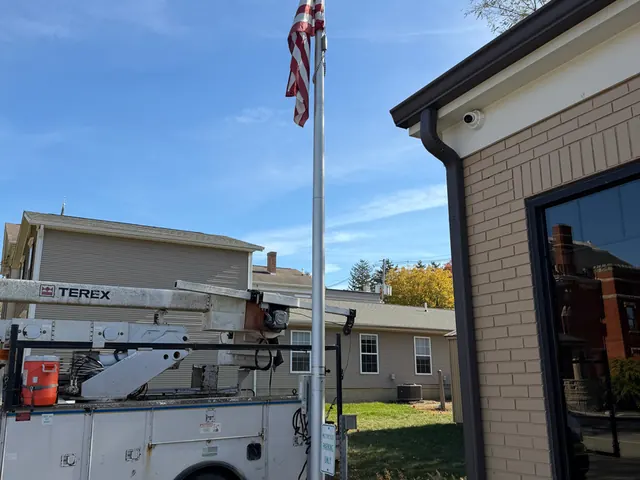
The bucket truck puts us level with the truck assembly, which is where the rope runs and where the fault usually is.
Check the pulley first
There is no point threading new rope through a seized pulley. If the bearing has gone, it gets replaced at the same time.
Run the new halyard
Fresh rope rated for the pole height, threaded, sized and terminated properly.
Tension, cleat and test
Rope tensioned so it does not slap, tied off at the cleat, flag raised and watched through a full cycle.
The detail that decides it
| What it means for re-stringing | |
|---|---|
| External halyard | Rope runs outside the shaft over a pulley at the top. Quick to re-string and simple to maintain. |
| Internal halyard | Cable runs inside the shaft with a counterweight and retainer rings. More involved, more parts, longer job. |
| Noise, external | Comes from snap hooks tapping the pole. Covers over the hooks largely solve it. |
| Noise, internal | Comes from the counterweight and retainer rings moving inside the shaft. Harder to quiet down. |
| Security, internal | The halyard is not reachable from the ground, which is why institutions often specify it. |
| Typical visit | External poles are usually finished in one visit. Internal systems occasionally need a return if a part has to be ordered. |
Why bring this job to us
Usually one visit
We carry halyard and pulleys, so the common failures get finished the day we come out.
Both systems handled
External and internal halyard. A lot of outfits will only touch external.
We fix the noise too
Snap covers fitted while we are up there, which is the complaint behind half these calls.
Signs your flagpole rope needs replacing
- The rope looks faded, fuzzy or stiff, or the outer braid has worn through to the core
- The flag sticks partway up or will not come down smoothly
- The rope has snapped and the flag is stuck at the top, or the rope has dropped off the pulley
- The rope slaps the pole and you cannot get it to hold tension at the cleat
- On an internal halyard pole, the cable has frayed or the crank and winch have gone stiff
If the rope has snapped with the flag still up, leave it there. Climbing a ladder against the shaft to reach it is how people get hurt, and the pulley that caused the break needs looking at anyway. Text us a photo of the top of the pole and we will tell you what we are bringing.
Questions about flagpole rope replacement
No, and this is the correction Jerry finds himself making more than any other. Internal systems carry a heavy counterweight on the cable to keep it taut, plus retainer rings that ride around the shaft. Those knock. A covered external rope and pulley setup is generally quieter, with an occasional ting at worst.
On a short residential pole you can lower, some people do. On anything tall enough to need a lift, it is not worth the risk, and working off a ladder against an aluminum shaft is how people get hurt. It is also easy to thread a new rope through a pulley that was the actual problem.
An external halyard pole is usually well under an hour once the truck is set up. Internal halyard poles take longer because the counterweight and retainer rings have to come out and go back correctly.
The halyard is the rope or cable that raises and lowers the flag. On most residential and many commercial poles it is a rope that runs up the outside of the pole, over a pulley in the truck assembly at the top, and ties off at a cleat near the bottom. On an internal halyard pole it is a cable that runs inside the shaft and is worked with a crank or winch behind a locked door.
It depends on sun exposure and how often the flag goes up and down, so there is no fixed date. Rope is a wear part. If it looks faded or fuzzy, or the flag no longer runs smoothly, it is due. We check the rope as part of a yearly maintenance visit, which catches it before it snaps.
Yes. We replace internal halyard cable as well as rope. It is a longer job than an external pole because the counterweight and retainer rings inside the shaft have to come out and go back correctly, and now and then a part has to be ordered for a return visit.
Related services
Where we do this work
We cover flagpole rope replacement and re-stringing across Indiana and Illinois from our base in Rockville.
Get your flagpole rope replaced
Call Jerry directly, or send a photo and get an answer without an appointment.