
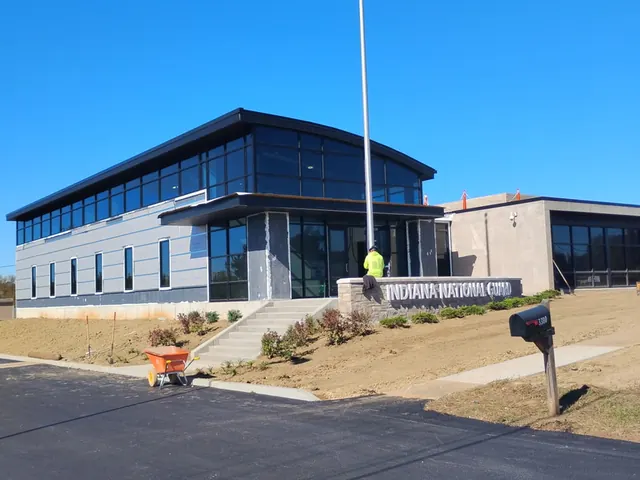
Residential and commercial
Flagpole Installation in the Midwest
A flagpole install is mostly a footing job. The shaft is the part people look at, but what decides whether the pole is still straight in fifteen years is the depth and diameter of the footing underneath it, and whether that was sized for the soil it went into. We set ours with structural post foam, not concrete, unless a site truly calls for a pour.
We install residential poles in lawns and commercial poles in parking lots, plazas and campuses. What changes the price is not usually the pole. It is what we are digging into, whether an old pole has to come out first, and whether the bucket truck can reach the spot.
How we handle it
Site assessment
We look at access, overhead lines, drainage, and what is under the surface. Utility locates get called before anything is dug.
Size the pole to the building
A single story house and a two story building do not take the same height. Getting this wrong is the most common regret we are asked to fix later.
Excavate and set the sleeve
The hole is dug to depth, the ground sleeve is set plumb, and structural post foam is set around it. Frost depth in this part of the country means this is not a shallow hole.
Raise the pole
Post foam takes load quickly, so on most installs the shaft goes up, the halyard and hardware get fitted, and the flag flies the same visit. On the rare site that genuinely needs a concrete pour, the footing cures first and the pole is raised on a return trip.
The detail that decides it
| Factor | Why it moves the price |
|---|---|
| Grass | The straightforward case. Dig, set the sleeve, foam the footing, backfill and reseed. |
| Concrete | The slab has to be cut and broken out, then patched back around the sleeve afterward. |
| Asphalt | Similar to concrete but the patch has to be done properly or it fails at the edges within a season. |
| Existing pole present | Removal is a separate operation with its own unknown, which is the old footing. |
| Single or two story | Sets the pole height that will actually look right against the building. |
| Bucket truck access | A pole in an open lawn is quicker than one in a courtyard the truck cannot reach. |
Why bring this job to us
Footings sized properly
We dig for the soil in front of us, not to a number off a sheet. That is what keeps a pole plumb.
Height that suits the building
We will talk you out of a pole that will look wrong. It costs us margin and saves you regret.
One crew, start to finish
The people who quote it are the people who install it. Nothing is handed to a subcontractor.
Questions about flagpole installation
For a single story house, 20 to 25 feet usually looks right. For a two story house, 25 feet is the common answer. Commercial buildings generally start at 30 feet and go up from there. The pole should read as part of the property rather than towering over it or disappearing beside it.
Most installs are a single visit. We dig, set the sleeve plumb, and set the footing with structural post foam, which takes load quickly enough that the shaft usually goes up the same day. If a site calls for a concrete pour instead, the footing has to cure and the pole is raised on a return trip. We will give you the actual dates when we schedule it.
Mark anything you know about that is underground, such as an irrigation line, an invisible fence or a septic field, because those do not show up on a standard utility locate. Then keep vehicles clear of the work area so the truck can get in.
Yes. We install commercial poles for schools, dealerships, offices, memorials and multi-pole sites, as well as residential poles. We own the bucket truck, so tall poles and parking lot installs are handled by our own crew from start to finish.
Yes. We can install a solar flagpole light when the pole goes in, so the flag is lit after dark without running power to the pole. If you want a wired system, we fit the StarGazer LED kit. See our flagpole lighting page for the lights we use.
Related services
Where we do this work
We cover flagpole installation across Indiana and Illinois from our base in Rockville.
Get flagpole installation booked
Call Jerry directly, or send a photo and get an answer without an appointment.